Customer Schemas: Turning Your Content Into A Map That Helps Your Champion Navigate Their Hero's Journey
April 22, 2023
"Early story is [science] fiction. Early majority is journalism. Late majority is biographies." - Evan LaPointe
By the time that a technology reaches the early majority phase of adoption, many or most practitioners recognize that it’s the future. But the challenge remains: how to get there?
As the Gatsby co-founder and now a principal engineer at Netlify, I’ve been answering that question for different users of Gatsby, the Jamstack, and the composable web, hundreds of times over the last few years.
Some of the things I've come to believe:
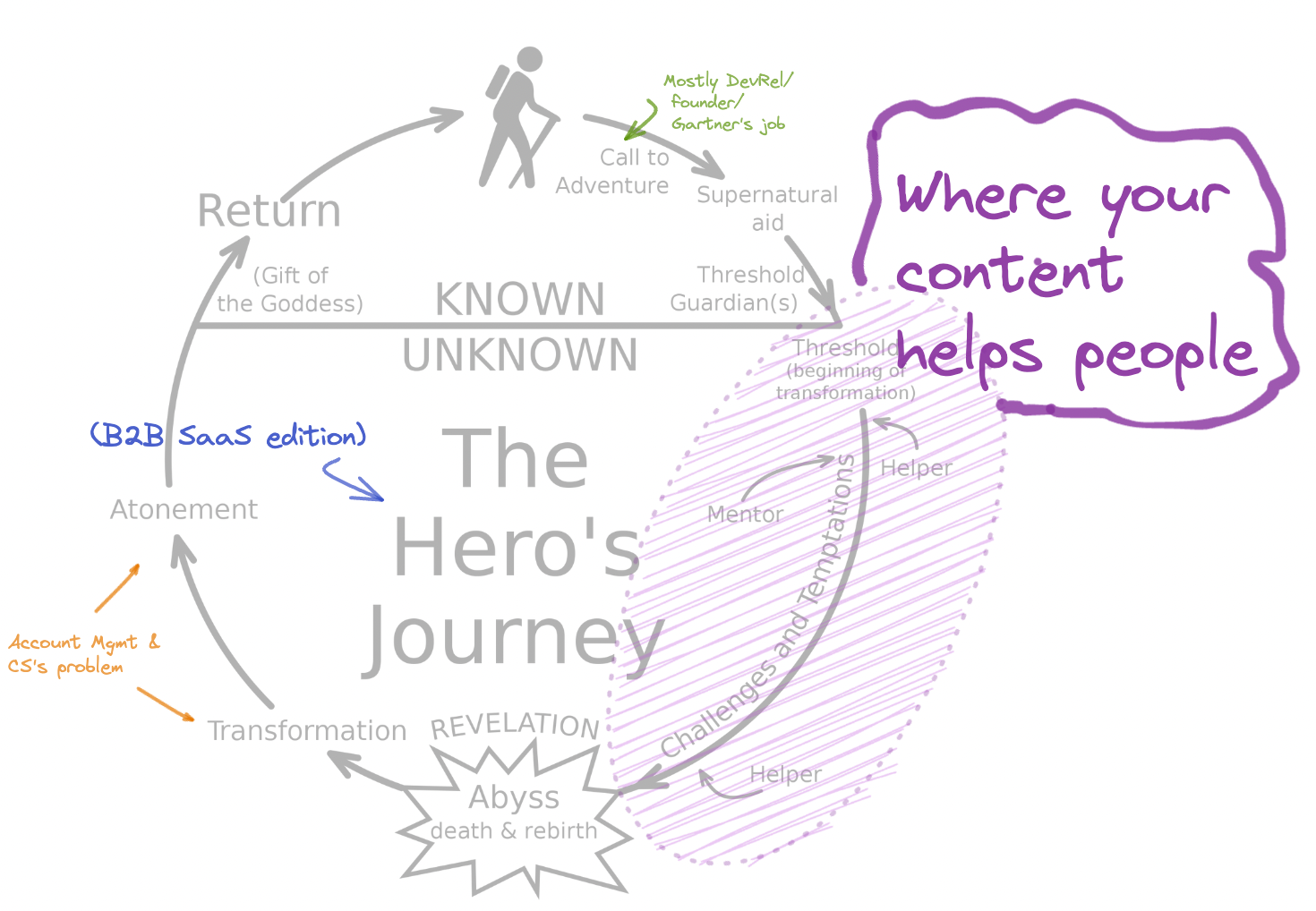
Your main audience is your champion, and they are a Hero on a Hero’s Journey. To bring your software into their organization, your champion is committing hundreds of hours, risking their reputation (and sometimes, their job) in hope of personal and organizational growth.
Consider them Frodo Baggins on a heroic quest to destroy the One Ring (the ancient, corrupt technology you’re replacing) in the fiery furnace of Mount Doom.
Your content is a map and an instruction manual, helping them make the journey from the Shire into and through Mordor. It illuminates the path that your salespeople and solutions engineers will help them walk.
You are the wise mentor or the helpful friend, the Gandalf or Samwise Gangee, to help them along their journey.
What I’m going to cover in this post is how to assemble your content into a map to guide your hero on their journey.
Make Your Content Comprehensive So Your Audience Knows It’s For Them
The two most common objections every potential customer asks when consuming any marketing material are, which they deploy constantly, is:
- Lack of credibility: “This is marketing BS.”
- Lack of relevance: “This isn’t for me.”
Credibility is earned at the level of individual content pieces. I’ve written elsewhere about different types of content and how to create them, so I won’t go into it too much. The basic formula is to create detailed examples of customer success that are deployed in production.
Relevance is earned at the content collection level. The formula is to make your content comprehensive, then accumulate & group proof points.
When you put credibility and relevance together, magic happens. People never believe marketing copy, rarely believe case studies, and sometimes believe collections of 2-3 relevant examples.
Both instances use the same basic approach: elbow grease.
You create a credible customer story by including lots of specific details. You create relevance by writing down lots of case studies. In both cases, it’s the volume and specificity of information that can break through your audience’s inherent skepticism.
In order to execute content collection well, you’ll want to create something I’ve termed a customer schema, which is made up of three parts.
First, a customer attribute catalog that covers all of the key dimensions of your funnel: for each stakeholder, including ecosystem technologies; including each product benefit and feature; at each level of product engagement (awareness, consideration, decision).
Second, a classification of existing customer-related content.
Third, a public-facing materialized view of your content database.
Let’s dive in.
Step 1: Create a Customer Attribute Catalog
The first step is to create a catalog of pertinent details and attributes that your customers have. This is the analytically complex part of the project.
How you approach this will depend on your background. Information professionals – think product managers or marketers, digital marketers, content folks – should lean on subject matter experts to help them sketch a rough outline at the beginning, as well as help them polish the final version.
The rationale here is both time efficiency and accuracy. Talking to the founder and an early sales rep for an hour at the beginning of the beginning of the project can save a lot of time later.
For subject matter experts, it’s important not to over-rotate on your industry expertise. Share your drafts for feedback with relevant folks to ensure you haven’t missed anything.
You should be able to get to a draft in a day or two with a couple initial conversations, combing through the website, and dropping Slack messages in the right channels. Sure, take the rest of the week for 1:1 conversations to refine your draft (and do try to find half-finished drafts of those who came before).
But don’t spend a month getting to a perfect version – that’s a waste of everyone’s time.
Data type | Who to talk to / where to find |
|---|---|
| Project stakeholder list | Sales reps & leaders |
| Industry | Create a report inside the CRM (data usually comes from Clearbit) |
| Key use-cases | Implementation, support, customer success |
| Key features | Website, product managers, solutions engineers |
| Key topics by stakeholder | Solutions engineers, analytics on blog posts & webinars, sales reps, call logs |
Different groups within an organization can help provide different information
In the age of Gong, the real thought leaders are the ones with access to call logs (and deal notes, and firmographic customer data….)
Identify the key 7-10 project stakeholders
When a company decides to spend five digits or up on a product, it’s rarely just one person’s decision.
A typical B2B SaaS has 1-2 “champion” roles driving tech adoption, 5-7 key stakeholders that need to buy in (or not object), and 1-2 decision-makers who need to approve budget. The specific people & roles may fluctuate a bit depending on customer industry & size, but there's usually a fairly fixed cap on the numbers.
At Netlify, these include:
- Champion: the tech lead
- Stakeholders: security, content team, digital marketing, design, agency, and IT
- Decision-makers: the CTO and business executives
Terminology matters. You’ll know you’ve found the right level of abstraction when your words are clear and straightforward, yet classify people as they see themselves. Be careful about segmenting too much by title or seniority, as it can interfere with this clarity.
Identify the top 10-15 technologies you’re associated with
Almost every piece of B2B software these days is used in an ecosystem with other software. Often, it's also replacing the previous generation of software as well.
Make a list of the ones that feel relevant to your customers. Generally, you should grab the top 10-15, which should map roughly onto technologies that you hear more than once when you talk to salespeople or solutions engineers.
For Netlify, these include:
- CMSs and e-commerce: Contentful, Contentstack, Sanity, Shopify
- Frameworks: Next.js and Gatsby
- Systems we’re replacing / augmenting: Sitecore, Drupal, AEM, WordPress, and homegrown CMS/e-commerce
Make sure to exclude categories of technology that aren't relevant to the specific decision they're making here.
Netlify customers' web stacks include a wide variety of (for example) styling libraries, monorepo build tools, and marketing analytics & automation, but these do not tend to be relevant in their choice of hosting platform.
Identify your top 10-15 industries & use-cases.
While early adopters tend to cluster in the technology world, that’s much less true of the early majority. Companies from different industries often have different goals for your software. What resonates in one industry may not resonate in another, and it's important to be mindful of that.
Netlify customers are typically pulled into various B2C industries; the use-cases are drawn from things people do with web sites:
- Industries: Retail & home goods, apparel/fashion, health & healthcare, consumer brands, gaming, SaaS, media & content, nonprofit, finance & insurance, travel & hospitality
- Use-cases: SaaS site, SaaS app, developer docs & content, e-commerce, SEO & lead generation, localized & multi-site, microsite or campaign site
Industries and use-cases are often fairly correlated. For example, one customer could be an apparel company running an e-commerce site that’s localized into multiple languages. Another might be a SaaS company with a site, app, and docs.
In terms of cutting and combining these buckets, two guidelines have worked well.
The first is to group similar uses together. For Netlify, most e-commerce stories are fairly similar, but different than SaaS (conversion focus vs developer productivity focus). Lead generation stories are different than either one, but more similar to e-commerce.
The second is to smooth bucket sizing. If you see buckets under 3-5% of revenue, go combine them with other buckets; if you see buckets over 20% of revenue, split them up. (Adjust these numbers if your company is very centered on one vertical.).
Finally, no set of buckets is perfect. You should try to have it fit 90-95% of your customers. You'll probably have a couple of smaller categories on the brink that you leave out and that's all right.
Catalog the top 10-15 features & customer benefits.
For products that are part of a larger ecosystem, this may be less about the specific features of the product and more about a new and better way of doing things.
If you've been in the space for a while and talk to customers, you should have a sense for these. If not, pigeonhole your sales team. Even better if you can catch a group of sales folks with beers in their hand.
- Features: instant rollbacks, redirects, branch-based deploys & deploy previews, build plugins & configuration (webhooks, notifications)
- Benefits: shipping faster, security & scalability, increased performance & conversion, increased SEO & traffic, reduced cost
Try to abstract the concepts into two-word phrases (a concept coined by former Netlify DX engineer Shawn Wang).
Catalog the top 10-15 topics by stakeholder
It's a truism that mediocre salespeople are talkers and great salespeople are listeners.
Great marketers know how to listen to what their customers are excited about, frustrated about, or scared by.
And then talk about those things.
These can include best practices discovered by sophisticated customers, implementation details and change management. It can also include features, benefits, use-cases, or associated technologies that are more specific to one stakeholder.
For Netlify, we’ve found these are:
- Tech lead: improving build speed, adding dynamic functionality, designing a site architecture, prototyping and demoing
- Stakeholders: content preview & content-driven page building (content), design systems & component libraries (design), agency best practices (agencies)
- Decision-makers: low-risk launches (CTO), staged migration (CTO), site scalability (CTO), improving customer experiences (business exec), reducing cost (business exec), composable (business exec).
Step 2: Classify existing content
Now it’s time to actually classify your content. You should probably start this process when you’re making your schemas, to see whether your content fits into the schemas you’re designing.
You want to focus on case studies, webinars, and other evergreen content from the last two to three years. A name brand from four years ago is less likely to still be relevant today.
If there is a piece of content which feels wrong, misleading, or perhaps like it was written with Chat GPT, I recommend you leave it off this schema. Outdated advice can be hazardous; Frodo and his companions chose to march through the mines of Moria not realizing the dwarves inside were dead.
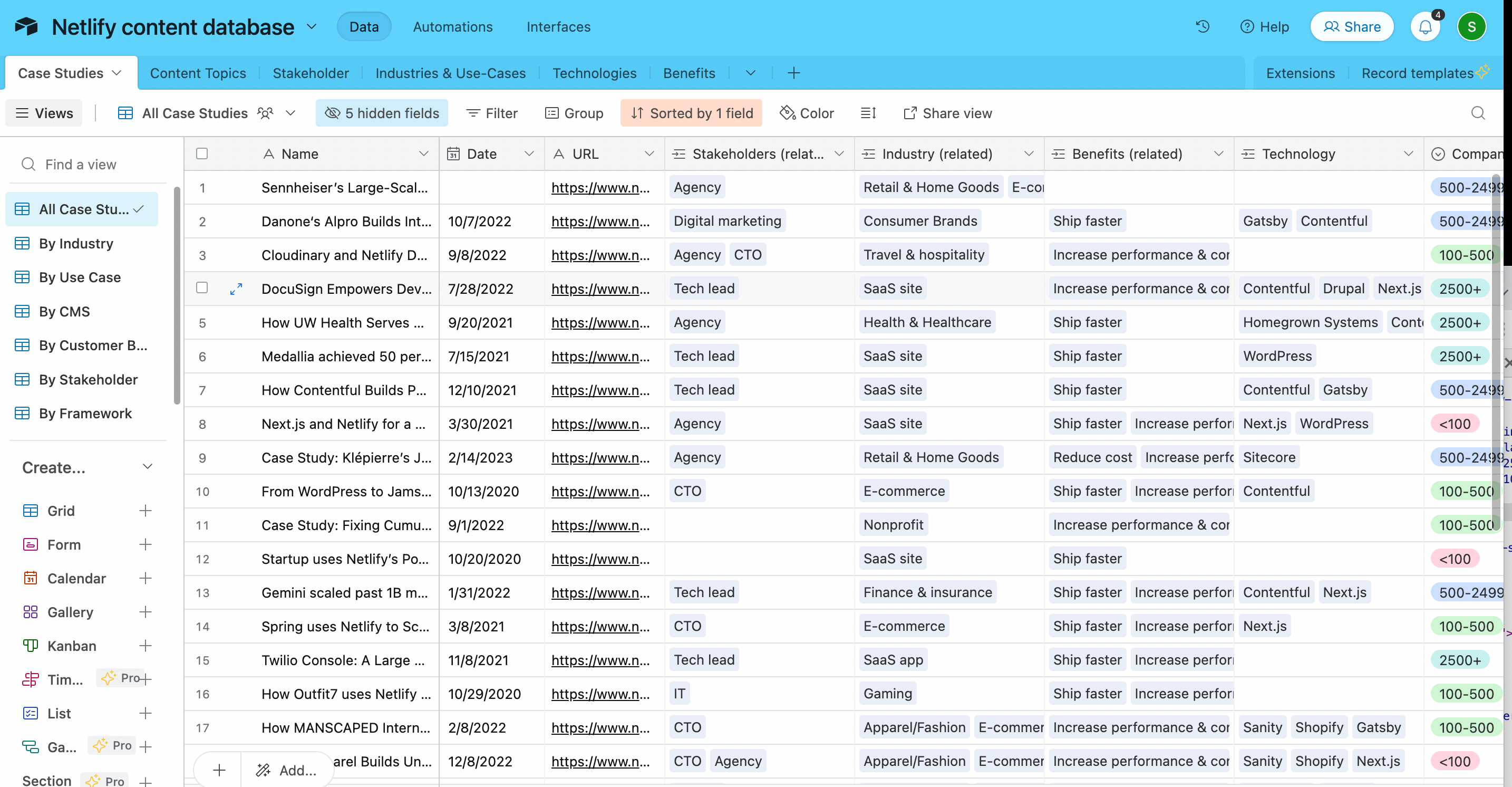
What system should you use? I have a strong bias in favor of Airtable/Notion over Google Sheets. This is because you’ll need to create relationships between objects, with reverse relationships created automatically, along with calculated fields, in order to identify content gaps.
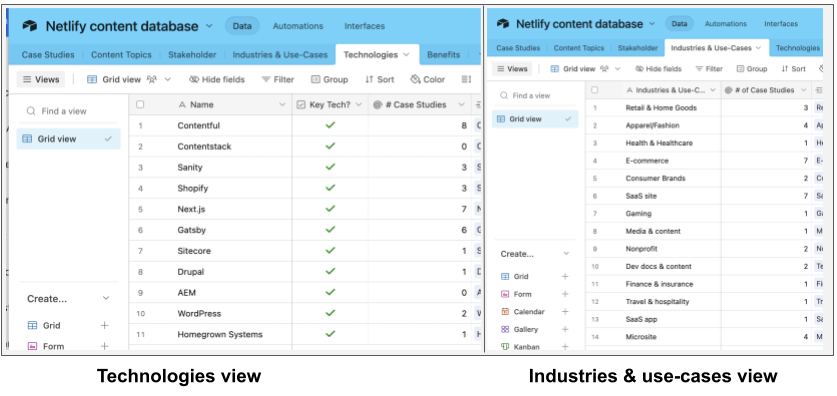
You’ll want to structure each axis mentioned above as an object. There may be other auxiliary fields, like country or company size, where picklists are fine.
Content classification can be slightly rote work; we’ve found it’s often more fun in pairs or groups. You need to create a database with a specific schema to achieve that.
Step 3: Publish your database on the web
It’s my firm belief that B2B SaaS companies should create public-facing content catalogs. Sure, Gatsby and Netlify are web companies, but my point of view is deeper than that.
First, the web is universally accessible, and in today’s sales world empowering your internal champions to find content they need goes a long way.
Second, organizations create a lot of internal content, but when something is officially published on the web it is seen as more canonical, both internally and externally. Blog posts are believed more than sales decks.
Publish in what form? There’s a lot of options. You could go the e-commerce route, and add a bunch of filters on a resources page. With a bit more work, you could generate a number of landing pages, linked from a top navigation bar, with “materialized views” of the underlying content schema.
Practically speaking, in order to do this, you may want to clone your Notion/Airtable schema into a tagging schema in your CMS (we’ve done this at Netlify with our CMS, Sanity).
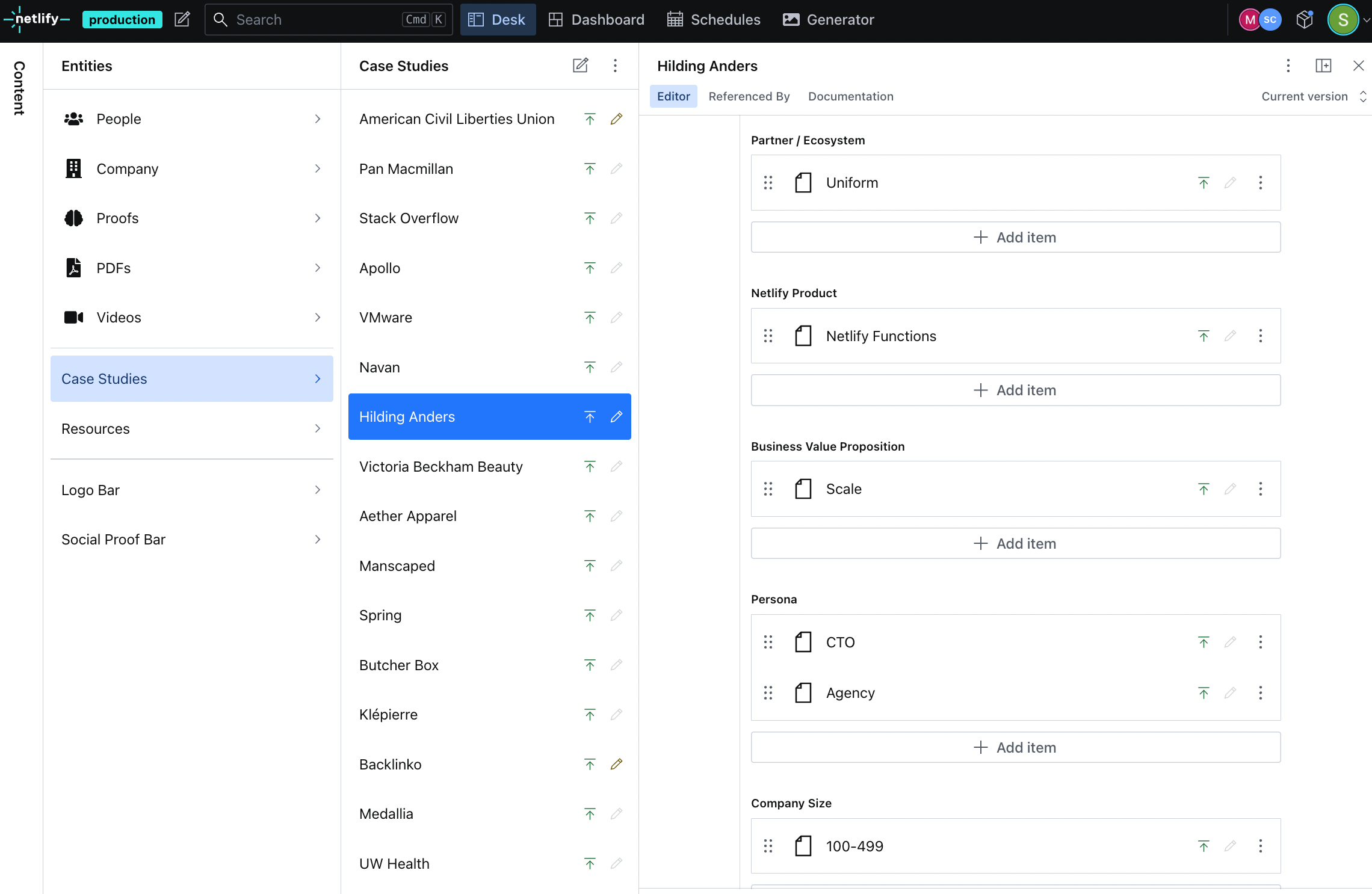
Our resource content tagging schema in Sanity
Step 4: assess content maturity by topic & plan accordingly
The first three steps might have taken on the order of weeks. Now is the long slog, which will take months: using your initial customer schema to flesh out your customers' journeys.
The first thing you'll need to do is to take stock of where you are, across a variety of topics. On any given topic, there are three levels of content maturity, and they each have their own playbook:
- Low maturity: 0-1 customer stories.
- Medium maturity: 2-6 customer stories.
- High maturity: 7+ customer stories
Low maturity topics
Low-maturity topics are a problem because if a salesperson says something like "can we get a case study for X industry [Y feature, Z integration], it comes up a lot but we don't have anything to send customers", it's a burning fire.
Hearing that phrase means you have sent the front line into a sticky situation without proper equipment, and you are quickly eroding their trust.
My advice is to put out the fire as quickly as possible with whatever is at hand.
(Customer hesitant about a case study? Write an anonymized one. Got a video interview? Transcribe it. Team member with first-hand experience? Schedule a webinar.)
It's as important that you do it quickly as that they see your urgency.
Medium maturity topics
Medium maturity topics are a backbone for a blog or webinar calendar or conference agenda. Audiences appreciate variety, and unsubscribe / mute / leave when bored, so sprinkling stories from a variety of different topics helps keep folks engaged.
If you've gotten a topic to medium maturity, you've probably developed at least a couple of relationships with folks willing and able to talk, write, or present about their experiences. (Even more if these folks are freelancers or work for an agency/consultancy since they'll always want more clients).
Medium maturity topics usually also provide the opportunity to write "top-of-funnel" pieces that summarize lessons from multiple related case studies (linking to them along the way) in a way that's authentic to the topic.
These can be good "canonical guides," whether for SEO purposes or as the one piece of content that a sales rep might send to a prospect after their first meeting.
Remember: when you put credibility and relevance together, magic happens. Multiple complementary, detailed proof points, organized in a customer schema and distilled into a canonical post, give you this opportunity.
High maturity topics
High maturity topics are an opportunity to launch lead-generation campaigns.
As marketing teams grow, they tend to align around quarterly thematic campaigns as a way to organize and coordinate.
High-maturity topics provide the underlying substance you'll need to write a substantive e-book, or an email sequence, or drive an ad-buy, or launch a fun quiz.
(Warning: launch a thematic campaign without a content backbone? Your marketing team, lacking real stories, may write filler copy. Your audience will likely tune out.)
Step 5: describe the bottom of your funnel in painstakingly precise detail
The most difficult part of our hero's journey is near the end.
As Frodo approaches Mount Doom, he is paralyzed by the giant spider Shelob and captured by orcs, but rescued by Sam. Walking into the mountain, he changes his mind and puts on the Ring. Gollum bites off Frodo's finger, but falls into the fire, destroying the Ring.
Every sales process has its twists and turns, and both the pitfalls and the success stories can have incredible levels of detail.
For example:
- E-commerce brands that evaluate new web tech by doing a performance bakeoff of a single PDP (product detail page).
- B2B SaaS that did a staged migration of a single site by fronting traffic with Netlify Redirects, avoiding a big-bang relaunch.
- Consumer conglomerate that spent millions of dollars on ads buying their brand name when bad performance hurt SEO enough.
These and dozens more details should show up, scattered through the stories you tell, phrased as observations, grouped poignantly in your canonical pieces.
It is these details that make your content into a useful map for your hero; it is on you to sketch Shelob's lair (legal/IT/procurement, say) and warn of the treachery of Gollum (perhaps a two-faced SI shop).
Conclusion
The map you create with your content does not replace your champion's courage.
But by doing thorough customer analysis, filling topic gaps, writing canonical summaries, some campaigns, and adding lots of details, you'll be able to help them get where they're going without being paralyzed by spiders or stabbed by orcs.